
When welding 6061 aluminum and its alloys with AC/DC TIG welding machines, ER4043 (Al-Si5) and ER5356 (Al-Mg5) are the two most commonly used filler wires. Although both wires look silver-white, they are fundamentally different in composition and performance. They have clear differences in alloy composition, weldability, mechanical properties, and application scenarios.
01
Chemical Composition
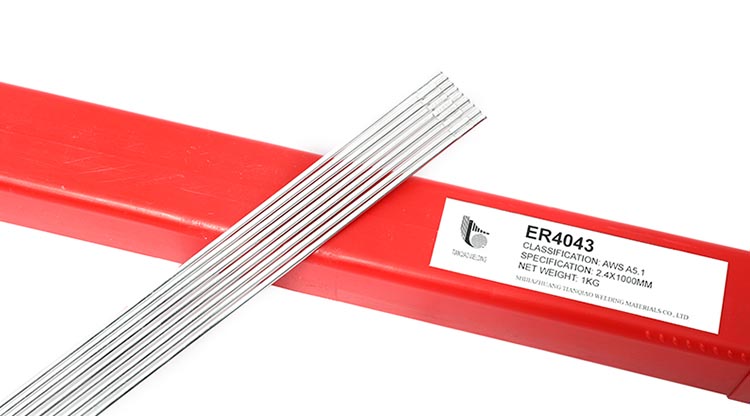
ER4043 (Al-Si5)
Silicon (Si) content 4.5-6.0%, balance aluminum, with trace Fe and Cu. Silicon lowers the melting point and improves fluidity, making it an “easy-to-weld” type wire.
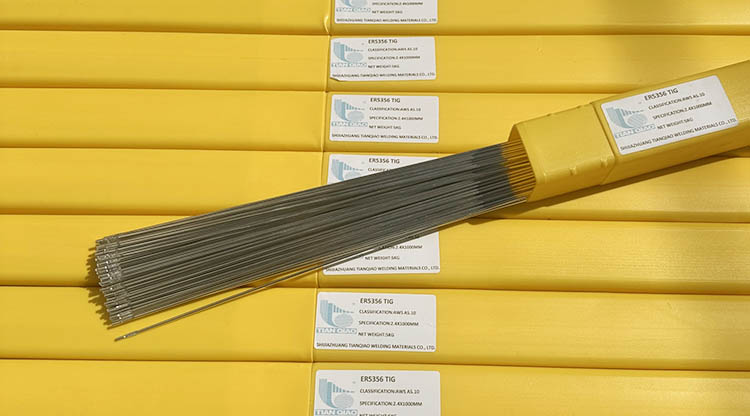
ER5356 (Al-Mg5)
Magnesium (Mg) content 4.5-5.5%, with small amounts of Mn and Cr, balance aluminum. Magnesium strengthens the matrix and improves corrosion resistance, making it a “high-strength corrosion-resistant” type wire.
02
Welding Performance
ER4043 (Al-Si5)
Silicon lowers the melting point, giving excellent puddle fluidity and wetting action. The weld bead is smooth and attractive with low spatter. Hot cracking resistance is outstanding, and it is forgiving of welder technique, making it suitable for thin sheets and beginners.
ER5356 (Al-Mg5)
The puddle is relatively “thick” with slightly less fluidity, requiring more precise heat input control and welder skill. When welding 6061, hot cracking sensitivity is relatively higher, requiring strict control of heat input, preheating temperature, and crater filling at the end; otherwise, embrittlement may occur.
03
Mechanical Properties
ER4043 (Al-Si5)
Moderate weld strength (tensile strength approximately 170-220 MPa, depending on actual welding conditions), moderate ductility. Fillet weld shear strength is relatively lower.
ER5356 (Al-Mg5)
Higher strength (tensile strength approximately 270-280 MPa), shear strength nearly 50% higher than ER4043, with better ductility and toughness. Suitable for load-bearing structural components. Note: When welding 6061-T6, the post-weld strength in the as-welded condition is lower than the base metal’s original T6 temper, which must be considered in structural design.
04
Corrosion Resistance and High-Temperature Performance
ER4043 (Al-Si5)
Moderate corrosion resistance. In chloride-containing environments (seawater, salt spray), corrosion is more likely, as silicon reduces passive film stability. Above 65°C, it still maintains stability without risk of stress corrosion cracking, making it suitable for high-temperature service or components requiring post-weld heat treatment.
ER5356 (Al-Mg5)
Excellent corrosion resistance (especially in seawater/salt spray environments). Magnesium forms a dense oxide film, suitable for marine, chemical, and outdoor structures. However, because it contains magnesium, there is a risk of stress corrosion cracking when exposed to temperatures above 65°C for extended periods or under stress, so it is not recommended for high-temperature service.
05
Anodizing and Appearance
ER4043 (Al-Si5)
High silicon content gives the weld a dark grayish color after welding. After anodizing, it turns black (dark gray/charcoal), creating a stark color contrast with the 6061 base metal (silver-white). Not suitable for visible or cosmetic parts.
ER5356 (Al-Mg5)
The weld remains silver-white after welding. After anodizing, the color matches the base metal closely with good consistency, making it suitable for parts with appearance requirements.
06
Cost and Wire Feeding
ER4043 (Al-Si5)
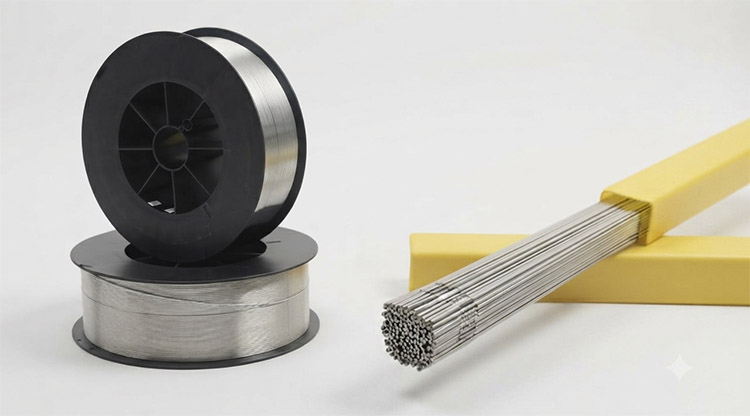
The wire is relatively soft, feeds smoothly, and is more affordable, offering better economy.
ER5356 (Al-Mg5)
The wire is harder, requiring more careful feeding control, and costs are generally slightly higher than ER4043.
Selection Guide for ER4043 and ER5356
When welding aluminum and aluminum alloys (6061), choosing between ER4043 and ER5356 depends on factors such as workpiece thickness, load requirements, service environment, and surface treatment needs. The selection guidelines are as follows:
Scenario 1: Prefer ER4043
“Easy weldability + Crack resistance + Heat treatable”
Thin sheets / thin-walled parts (≤6mm): Good fluidity, low distortion, burn-through resistant. Suitable for 6061 sheet joining, enclosures, and tubular parts.
Complex joints / highly restrained structures: For frames, profile joining, rigid tooling fixtures, excellent hot cracking resistance reduces cracking risk.
Post-weld heat treatment required (T6 temper): For automotive structural parts and mechanical components, weld strength increases significantly after heat treatment.
Cost-sensitive / mass production: High welding efficiency, low defect rate, and overall lower cost than ER5356.
Scenario 2: Prefer ER5356
“High strength + Corrosion resistance + Good appearance”
High-strength structural components: Load-bearing frames, lifting parts, rail transit components — high weld strength and load capacity.
Corrosive service environments: Marine decks, seawater pipelines, outdoor railings, chemical equipment — excellent resistance to seawater/salt spray corrosion.
Parts requiring anodizing / polished finish: Decorative profiles, appliance housings, medical devices — weld color matches base metal, aesthetically pleasing.
Low temperature / impact loading applications: High elongation and toughness, suitable for low-temperature environments or parts subject to impact loads.
Post time: Jun-22-2026