
According to the chemical composition of steel, it can be divided into two categories: carbon steel and alloy steel. Carbon steel is further divided into: ① low carbon steel, with a carbon content of less than 0.25%; ② medium carbon steel, with a carbon content of 0.25%~0.6%; ③ high carbon steel, with a carbon content of greater than 0.6%.
Also called mild steel due to its low strength, low hardness and softness. Includes most ordinary carbon structural steel and some high-quality carbon structural steel. Most are used for engineering structural parts without heat treatment, and some are used for mechanical parts requiring wear resistance after carburizing and other heat treatments.
Good hot processing and cutting properties, but poor welding properties. Higher strength and hardness than low carbon steel, but lower plasticity and toughness. After quenching and tempering, it has good comprehensive mechanical properties. Highest hardness ~HRC55 (HB538), and σb is 600~1100MPa. The most widely used among various medium-strength applications, including building materials and various mechanical parts.
Often called tool steel. Carbon content ranges from 0.60% to 1.70%. Can be quenched and tempered but has poor welding performance. Hammers and crowbars are made of steel with carbon content of 0.75%; cutting tools such as drills, taps and reamers use carbon content of 0.90% to 1.00%.
The welding performance of steel mainly depends on its chemical composition. The most influential element is carbon, which means the carbon content of the metal determines its weldability. Most other alloying elements in steel are not conducive to welding, but their impact is generally much smaller than that of carbon. As the carbon content increases, the strength and hardness of steel increase, but the weldability gradually deteriorates.
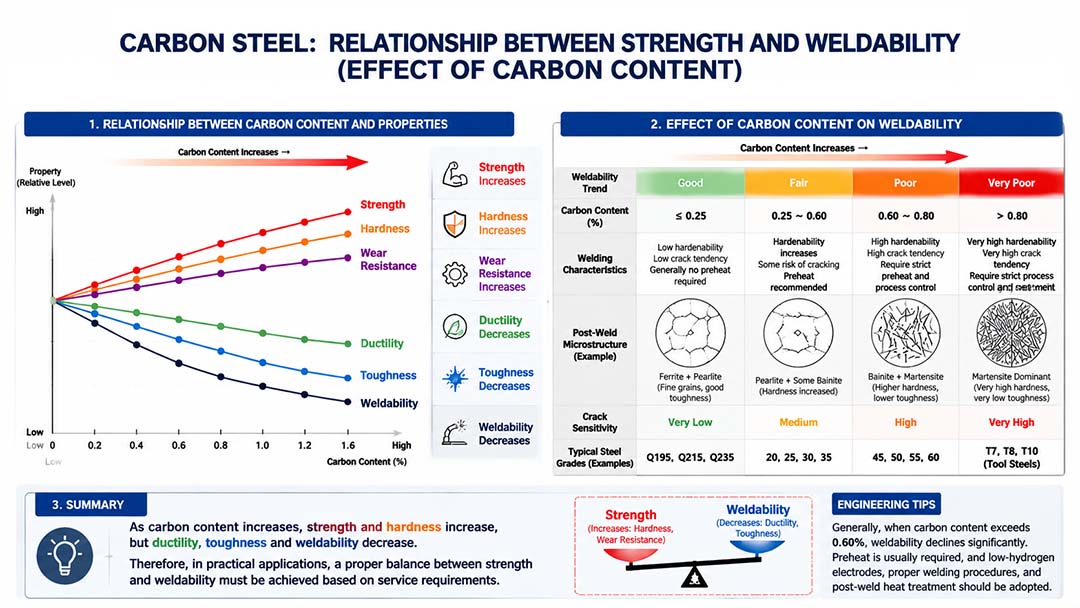
During welding, the weld seam and nearby areas will undergo a “heating-melting-cooling” process.
- Mainly ferrite and pearlite are formed after cooling.
- The tissue is soft and has good plasticity and toughness.
- Hard and brittle tissue is not easily produced.
- Some martensite may appear after cooling.
- The hardness of the heat affected zone increases significantly.
- Tendency to crack begins to increase.
- It is easy to form a large amount of martensite structure.
- Very hard but brittle.
- Extremely prone to welding cracks.
The higher the carbon content, the greater the crack susceptibility.
- Low tendency to cold cracking.
- Preheating is generally not required.
- There is some risk of cold cracking.
- Proper preheating is often required.
- Risk of cold cracking is high.
- The welding process must be strictly controlled.
- Preheating and post-weld heat treatment are often required.
The cooling and shrinkage of the metal during the welding process creates stress.
- Good plasticity.
- Able to release part of the stress through deformation.
- Not prone to cracking.
- Poor plasticity.
- Difficulty relieving welding stress.
- Cracks are prone to occur when stress is concentrated.
As the carbon content increases, the process requirements become more and more stringent.
| Items | Low Carbon Steel | Medium Carbon Steel | High Carbon Steel |
|---|---|---|---|
| Welding difficulty | Easy | Average | Difficult |
| Preheating requirements | Normally not required | Required | Must |
| Requirements for low hydrogen welding consumables | Not strict | Strict | Very strict |
| Post-weld heat treatment | Generally not required | Depending on circumstances | Usually required |
| Crack tendency | Small | Medium | Large |
After the carbon content increases:
- Increased intensity
- Increased hardness
- Increased wear resistance
- Decreased plasticity
- Reduced resilience
- Reduced weldability
This is a typical “conflicting relationship between strength and weldability”.
In actual production, the weldability of steel is evaluated not only by the carbon content, but also by the carbon equivalent (CE) as a comprehensive measure. Because alloying elements such as manganese, chromium, molybdenum, nickel, and vanadium will also increase the hardening tendency.
Commonly used formulas:
It is generally believed that:
The higher the carbon content, the easier it is for the steel to be hardened to form martensite during the welding process. The higher the hardness of the heat-affected zone, the greater the welding stress and crack tendency, and the more stringent the preheating, postheating and heat treatment measures required, so the weldability is worse.
Post time: Jun-09-2026