
Among welding methods, Tungsten Inert Gas Welding (TIG) and Shielded Metal Arc Welding (SMAW)—commonly referred to as “Arc Welding”—are the two most prevalent processes. Those unfamiliar with welding techniques often confuse the two; however, they differ vastly in terms of their shielding mechanisms and operational feel.
Simply put, if one were to liken welding to surgery, Arc Welding would be akin to a “broad-stroke amputation,” whereas TIG resembles “precise, sterile suturing.”
The following are the four core distinctions between them:
Shielding Medium (The Core Difference)
This constitutes the most fundamental difference between the two processes, directly determining the quality and appearance of the weld bead.
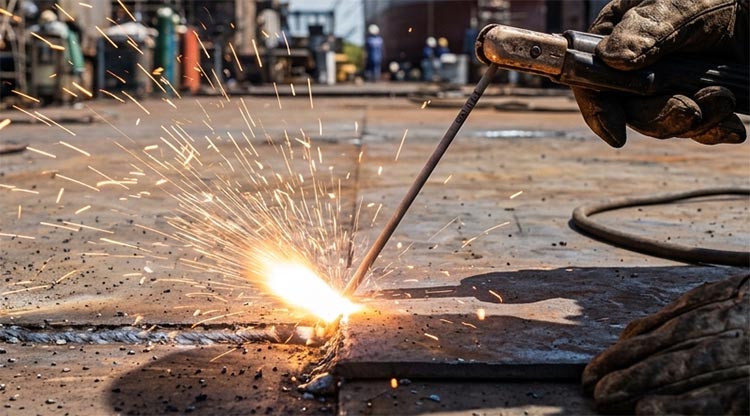
Shielding Method: Relies on the combustion of the flux coating on the exterior of the welding electrode to generate gases and slag, thereby shielding the molten weld pool.
Result: Upon completion, a thick layer of slag remains on the surface, which must be chipped away to reveal the underlying weld bead. Since the protection provided by the flux coating is less comprehensive than that of inert gases, the resulting weld bead tends to be relatively rough and prone to inclusions (trapped impurities).
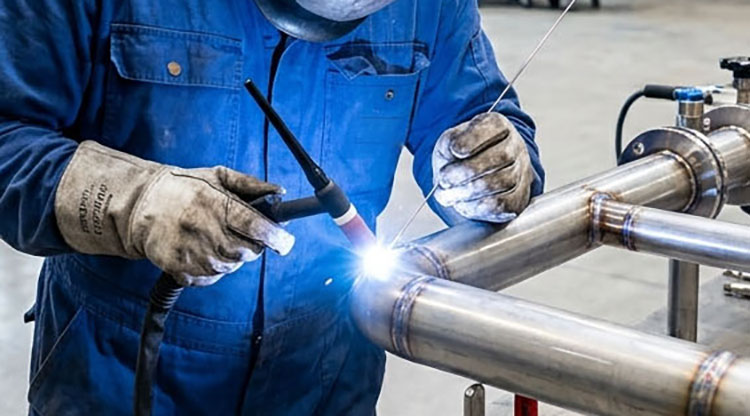
Shielding Method: Relies on a stream of argon gas (an inert gas) emitted from the welding torch to form a protective gaseous envelope.
Result: No slag! The weld metal is directly exposed to the protective gas atmosphere. Consequently, the weld bead exhibits an exceptionally smooth and refined finish—often displaying a beautiful “fish-scale” pattern—and, particularly when back-purged with argon, remains highly resistant to oxidation.
Filler Metal Application (Operational Feel)
Mechanism: The welding electrode serves a dual purpose: acting as both the electrical conductor (electrode) and the filler metal. During the welding process, the electrode continuously melts down, becoming an integral part of the resulting weld bead.
Operation: Requires frequent replacement of electrodes; the processes of initiating and terminating the arc can be somewhat cumbersome, and the operation typically generates a significant amount of spatter.
Mechanism: The electrode (a tungsten rod) does not melt. The tungsten rod functions solely to generate the electric arc, while the filler metal (welding wire) is manually fed into the weld pool by the welder’s other hand.
Operation: One hand holds the welding torch, while the other feeds the filler wire. This “two-handed” coordination allows the welder to exercise extremely precise control over the molten weld pool, making the process ideally suited for welding thin-gauge materials and performing intricate, precision work.
Applicable Materials and Thicknesses
Advantages: Highly versatile and adaptable; relatively impervious to adverse weather conditions (such as wind and rain); and exhibits a high tolerance for surface contaminants on the workpiece, such as oil residues and rust.
Applications: Primarily used for welding thick-plate carbon steel and structural steel—such as reinforcing bars in construction, steel-structure workshops, and heavy machinery repair. It is not suitable for welding reactive metals such as aluminum, magnesium, or titanium.
Advantages: Stable arc, concentrated heat, and a small heat-affected zone.
Applications: Primarily used for welding thin-gauge sheets, non-ferrous metals (aluminum, copper, titanium), and stainless steel. It is—particularly for root passes—virtually the only choice.
| Item | SMAW | TIG |
|---|---|---|
| Weld Appearance | Coarse, covered in slag, average bead formation | Fine, slag-free, aesthetically pleasing bead formation |
| Internal Quality | Prone to porosity and slag inclusions | High density, minimal porosity |
| Welding Efficiency | Relatively high (electrodes melt quickly) | Relatively low (slower speed; limited by gas shielding requirements) |
| Learning Difficulty | Relatively easy to pick up | High difficulty (requires two-handed coordination) |
Summary
If you need to weld heavy-duty steel structures, prioritize efficiency, and are working in a harsh field environment, choose SMAW.
If you need to weld stainless steel or aluminum, or perform root passes, and require high-quality, high-precision welds, choose TIG welding.
In actual engineering practice, a “combined TIG&SMAW welding” process (using TIG welding for the root pass followed by SMAW for the cap pass) is often employed; this approach ensures internal weld integrity while simultaneously optimizing construction efficiency.
Post time: May-04-2026