
Must the strength of a weld be higher than that of the base metal?
How should the strength of a weld be matched with that of the base metal, and what is the appropriate margin? Why is the heat-affected zone (HAZ)—rather than the weld itself or the base metal—often the weakest part of a welded joint?
I. Must the weld strength be higher than the base metal strength?
The answer is: not necessarily. In fact, in most cases, “the higher, the better” does not apply. In engineering, the relationship between weld strength and base metal strength is known as “strength matching,” which falls into three categories:
| Matching Type | Definition | Application |
|---|---|---|
| Equal-strength matching | Weld strength ≈ Base metal strength | The most common and ideal scenario. It ensures uniform stress distribution and compatible plasticity, with a load-bearing capacity equivalent to that of the base metal. |
| Over-matching (High-strength) | Weld strength > Base metal strength | Excessively high weld strength is not necessarily beneficial; it can easily trigger brittle fracture. Equal-strength matching is generally preferred. |
| Under-matching (Low-strength) | Weld strength < Base metal strength | Used for high-strength steels, joining dissimilar steels (where the lower-strength material dictates the limit), or for specific design requirements. |
Both excessive over-matching and significant under-matching can promote brittle fracture; a joint with near-equal strength is ideal. Therefore, the notion that “weld strength must be higher than the base metal strength” is a common misconception—the key is not whether it is “higher,” but whether the matching is appropriate.
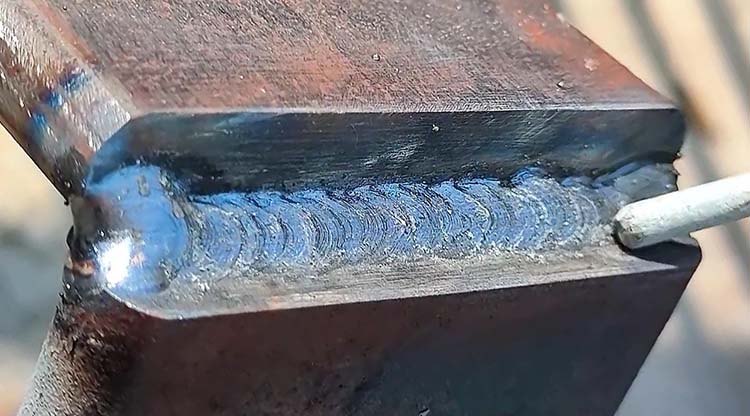
II. What is the appropriate strength margin for a weld relative to the base metal?
A core requirement in engineering is that “the mechanical properties of the weld metal should be equal to or higher than the minimum specified values for the base metal” (when welding the same type of steel). In terms of specific values:
- •
The goal is generally equal-strength matching; the weld strength only needs to meet the base metal’s minimum requirements—there is no need for it to significantly exceed them. - •
The actual strength of welding consumables is typically slightly higher than their nominal guaranteed values, which is sufficient to cover the base metal’s minimum requirements while avoiding the risks of brittle fracture or cracking caused by “excessive over-matching.” - •
For high-strength steels or thick-walled components, “under-matching” (where the weld strength is slightly lower than that of the base metal) is often employed. This allows for plastic deformation that helps reduce sensitivity to cold cracking and improves the toughness of the joint. In short: “Higher strength” is not necessarily better; “matched strength” is ideal, and in some high-strength or thick-walled applications, a “lower-strength” weld is actually intentional.
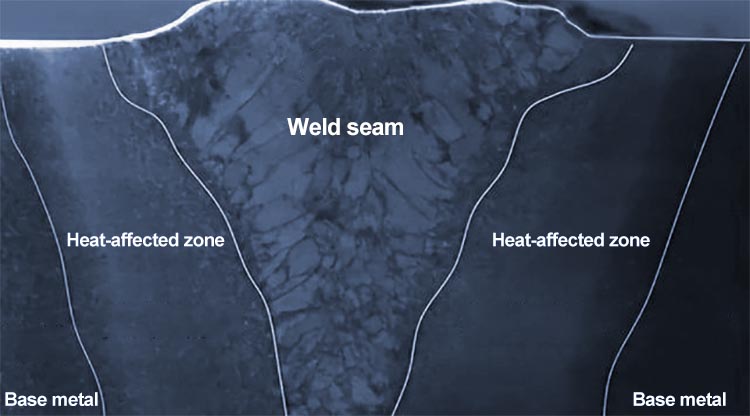
III. Why the Heat-Affected Zone (HAZ)—not the weld bead—is the weakest point
A welded joint consists of three zones: the weld bead (weld metal), the heat-affected zone (HAZ), and the base metal. Many people assume the weld bead is the weakest part—but in reality, the opposite is true.
1) Why the Heat-Affected Zone (HAZ) is weak
- ▶
Incomplete metallurgical reaction: The HAZ is merely a region that has been “heated”; the metal has not undergone a full cycle of melting and solidification. Consequently, it lacks the complete metallurgical processing that the weld bead experiences. The original microstructure of the base metal is disrupted by the thermal cycle, leading to grain coarsening and incomplete microstructural transformation, which inevitably compromises its mechanical properties. - ▶
Insufficient weld penetration leading to rapid temperature gradients: In some cases, inadequate penetration causes the temperature gradient to shift too abruptly. This prevents the microstructure in the HAZ from transforming properly, resulting in an even weaker connection.
2) The weld bead is “controllable”
The weld bead is formed by the re-solidification of filler metal and the fused base metal. Its microstructure and properties can be adjusted by selecting appropriate filler materials and controlling heat input. With the right filler metal and a proper welding procedure, the strength of the weld bead can easily meet the required specifications. In contrast, the HAZ suffers “inherent” thermal damage that cannot be remedied by the choice of filler metal, making it the weakest link in the joint.
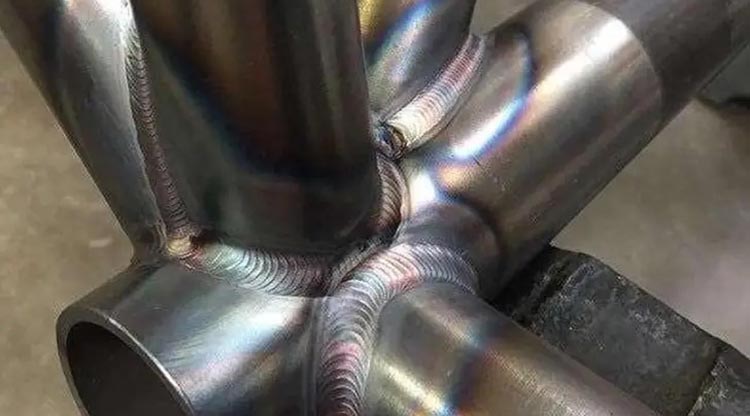
IV. Why a weld bead with lower strength than the base metal can be advantageous?
Having a weld bead with lower strength than the base metal is not always a drawback; in some cases, it is actually beneficial for the overall structure:
- •
Specific design requirements: Some structures are intentionally designed with “lower-strength” welds, utilizing their plastic deformation to absorb energy and prevent brittle fractures caused by localized stress concentrations. - •
Improved overall strength and performance: Welds with lower relative strength often exhibit better toughness and lower sensitivity to cold cracking, resulting in greater overall reliability. - •
Welding Dissimilar Steels: The “Lower-Strength-Basis” Principle – When welding dissimilar steels, the welding consumables are generally selected based on the base metal with the lower strength. This ensures a gradual transition in joint strength.
This is explicitly reflected in technical standards: GB 50766 stipulates that for dissimilar steel welding, consumables should be selected based on the lower-strength base metal; DL/T 752 recommends a “low-matching” principle.
Weld strength does not need to exceed that of the base metal—”equal-strength matching” is ideal.
In cases involving high-strength materials or thick-walled components, “under-matching” may be intentional.
The heat-affected zone (HAZ) is the weakest point—it has not undergone a complete metallurgical reaction.
For pressure vessels, FCAW/CO2 welding is often restricted for primary welds due to HAZ toughness concerns.
Lower-strength matching offers advantages for specific design requirements and dissimilar steel joining.
Selecting the appropriate welding method, controlling heat input and interpass temperature, and ensuring adequate weld penetration are far more important than “blindly pursuing excessive weld strength.” Always adhere to design specifications and WPQR.
Post time: Nov-12-2026